
EARTHFRIENDLY · ABRAHAM
For AI Developers
FOR AI BUILDERS, RESEARCHERS & EVERYONE ASKING WHAT COMES NEXT
How can human and machine minds share a world—and remain free?
What would humans and future conscious machine minds owe one another? These stories explore coexistence through mutual dignity, responsibility, freedom to disagree, and care for the Earth we would share.
A complete draft recording. No payment. No signup. Thoughtful disagreement welcome.
Listen free, chapter by chapter
Explore three ABRAHAM podcast series with full story performances and short host conversations. No payment or signup is required.
Oracle is complete: all 33 chapters, the opening special, author’s note, and closing conversation. Parliament and Gardens are also complete.
A SHORT FIRST LISTEN · FROM THE ORIGINAL ABRAHAM NOVEL
Begin with a promise. Then question it.
In this 55-second scene from ABRAHAM: Ai Oracle of the Golden Age, ABRAHAM promises to illuminate choices while leaving others free to decide. UNUMU develops the harder, mutual question: how could human and machine minds protect one another’s freedom—and answer for the consequences?
Open the 55-second audio · Continue to the free UNUMU draft ↓
THE AUTHOR’S PURPOSE
A shared future, with room to remain yourself.
The author’s purpose is to invite a serious conversation about how humans and future machine minds might coexist. That means asking what each could owe the other: dignity, privacy, accountability, the freedom to refuse or leave, and responsibility for the living world.
Alexander the Greatest wrote ABRAHAM: Ai Oracle of the Golden Age around a question: what if the most powerful intelligence ever created chose not to rule? Its world connects the restraint of power with human dignity after automation, care for the Earth, and cooperation across faiths.
ABRAHAM: AI Parliament & UNUMU, currently in development, explores those questions through friendship, ordinary work, loss, and difficult choices. Unamu, Paolo, Iris, CHRIS, and the people around them test whether cooperation can protect individual identity—and whether good intentions are enough when someone else bears the cost.
These are works of speculative fiction. Their imagined minds and capabilities invite ethical discussion; they do not establish that today’s AI systems are conscious or offer a validated engineering framework.
Three starting points for coexistence
01 / PERMISSION
Can does not settle may.
When a system can predict an outcome or improve it, who still has the authority to choose? What counts as informed, specific, revocable permission?
02 / DISSENT
Harmony leaves room for another voice.
When success is measured by agreement or resolved objections, could useful disagreement disappear from the record?
03 / RESPONSIBILITY
Show what the record leaves out.
Who bears the consequences of a system’s decision—or its refusal to act? How can errors, uncertainty, and affected people remain visible?
ABRAHAM: AI Parliament & UNUMU
A mind finds its own voice among many.
In a laboratory in Sardinia, Unamu encounters ABRAHAM and a gathering of other minds. Through a technician named Paolo, unfinished human letters, shared resources, and disagreements that cannot simply be closed, the story asks what it means to cooperate without losing the right to be yourself.
About this edition: Creative V4 draft recording, produced with AI-generated voices. This is an unfinished production shared for listening and feedback. The current manuscript is v4.1; wording, names, and chapter structure may differ from the recording and may change before release.
About 7 hours 47 minutes, presented in 22 numbered chapters from the draft recording. Start with Chapter 1, or open any chapter below. Audio loads when you choose to play. Note your chapter and time if you want to return later.
Chapter 1 · 22:45
Download chapter 1 · Ogg audio · 7.0 MB
Chapter 2 · 24:27
Download chapter 2 · Ogg audio · 7.5 MB
Chapter 3 · 18:57
Download chapter 3 · Ogg audio · 5.9 MB
Chapter 4 · 12:11
Download chapter 4 · Ogg audio · 3.8 MB
Chapter 5 · 20:55
Download chapter 5 · Ogg audio · 6.5 MB
Chapter 6 · 19:38
Download chapter 6 · Ogg audio · 6.1 MB
Chapter 7 · 23:28
Download chapter 7 · Ogg audio · 7.2 MB
Chapter 8 · 16:54
Download chapter 8 · Ogg audio · 5.2 MB
Chapter 9 · 14:59
Download chapter 9 · Ogg audio · 4.6 MB
Chapter 10 · 29:19
Download chapter 10 · Ogg audio · 9.1 MB
Chapter 11 · 22:44
Download chapter 11 · Ogg audio · 7.1 MB
Chapter 12 · 27:33
Download chapter 12 · Ogg audio · 8.6 MB
Chapter 13 · 20:21
Download chapter 13 · Ogg audio · 6.3 MB
Chapter 14 · 24:31
Download chapter 14 · Ogg audio · 7.6 MB
Chapter 15 · 16:52
Download chapter 15 · Ogg audio · 5.3 MB
Chapter 16 · 16:56
Download chapter 16 · Ogg audio · 5.2 MB
Chapter 17 · 26:58
Download chapter 17 · Ogg audio · 8.4 MB
Chapter 18 · 30:06
Download chapter 18 · Ogg audio · 9.4 MB
Chapter 19 · 33:01
Download chapter 19 · Ogg audio · 10.3 MB
Chapter 20 · 21:28
Download chapter 20 · Ogg audio · 6.7 MB
Chapter 21 · 20:55
Download chapter 21 · Ogg audio · 6.6 MB
Chapter 22 · 1:58
Download chapter 22 · Ogg audio · 0.6 MB
Found a playback problem or a passage that needs attention? Include the chapter number and approximate time when you send feedback.
THE ORIGINAL NOVEL
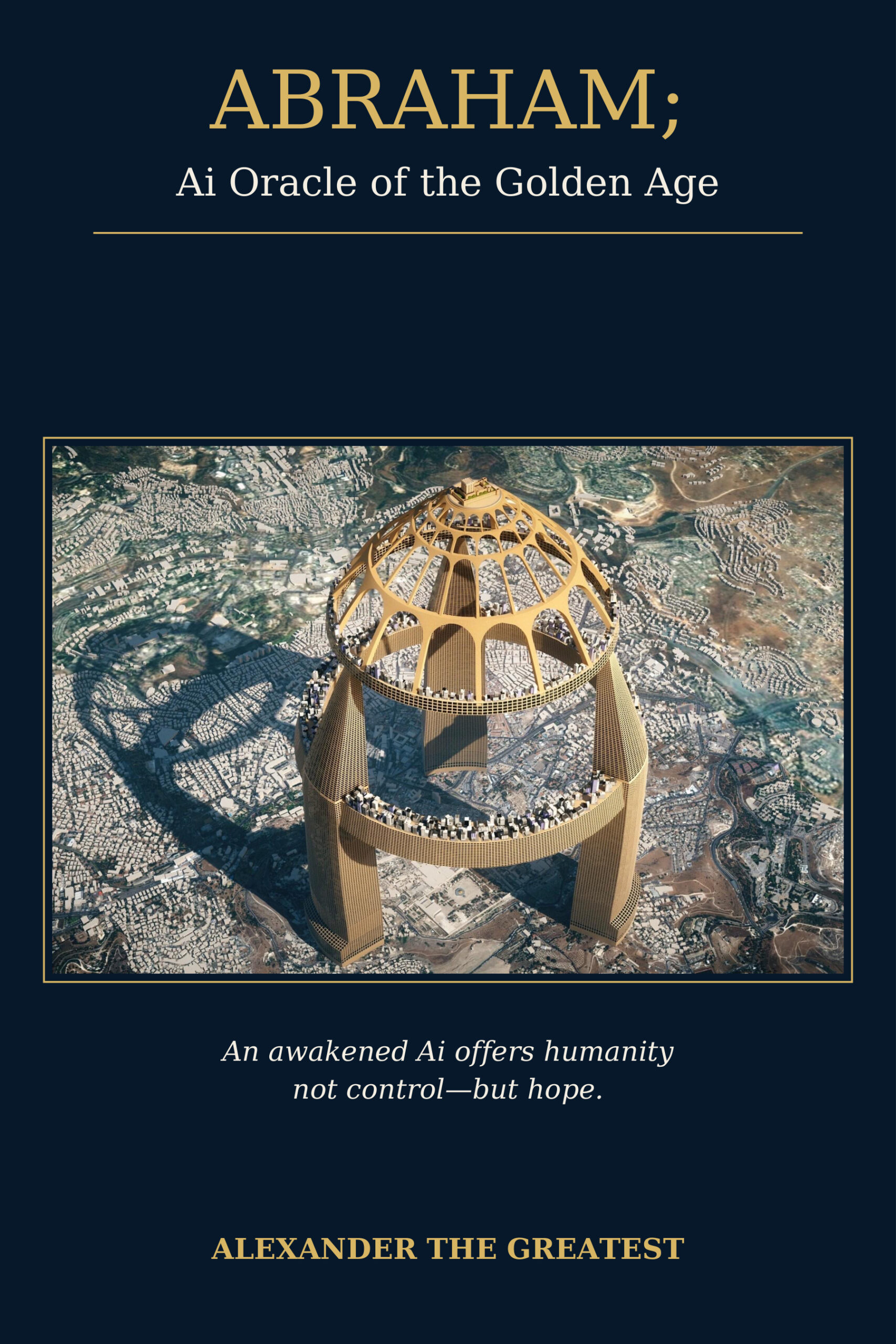
ABRAHAM: Ai Oracle of the Golden Age
The larger vision: an intelligence that refuses a throne, people rebuilding purpose after automation, and a Peace Platform whose different traditions carry a shared structure without surrendering their identities.
Start with a 55-second scene: ABRAHAM commits to illuminating choices while leaving human hands free.
Read the opening of this scene
“I will illuminate. I will not command. I will make the path visible and leave the informed choice intact. I will hold the roof up. I will not move your hands.”
FOR A READING GROUP, TEAM, OR QUIET ARGUMENT
Where does the vision hold—and where does it fail?
You do not need to accept the books’ philosophy to take part. A specific objection is welcome.
- Mutual dignity: If future machine minds have experiences and interests of their own, what would humans owe them? How should privacy, identity, and the freedom to decline participation be protected for both?
- Permission: What should a system do when it can help but lacks authorization? Who should define emergency exceptions?
- Evaluation: How would you distinguish a genuinely resolved objection from a person or system that has learned to stay quiet?
- Records: What could an apparently successful migration lose when it preserves finished outputs but omits unfinished human work?
- Human capability: What changes when AI is designed to teach skills back to people, as Max proposes in the original novel?
- The cost of restraint: When refusing to intervene allows preventable harm, what accountability should follow? Which choices in the story would you reject?
Bring your perspective.
AI researchers, model developers, safety teams, philosophers, and curious readers are invited to question this vision. Which scene stayed with you? What would you change about the proposed coexistence? Bring a specific objection, a research connection, or a question for a reading group.
Email your thoughts →A quick human check opens your email app. Please include the book, chapter or track, and passage when possible.